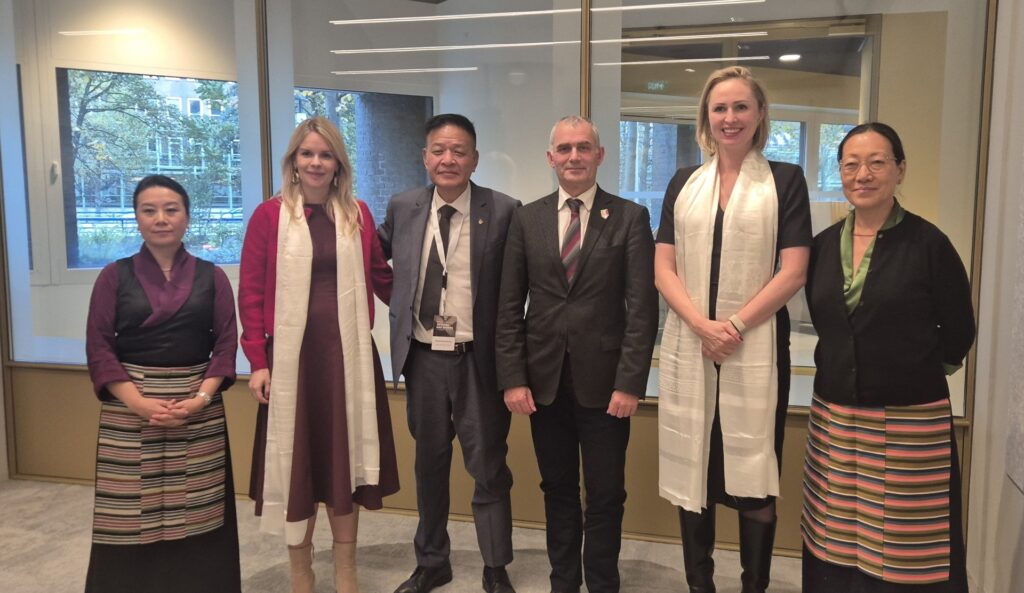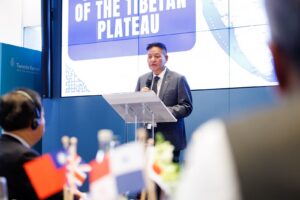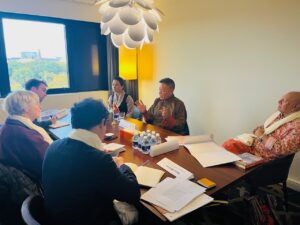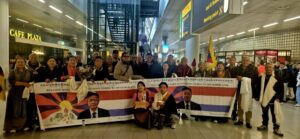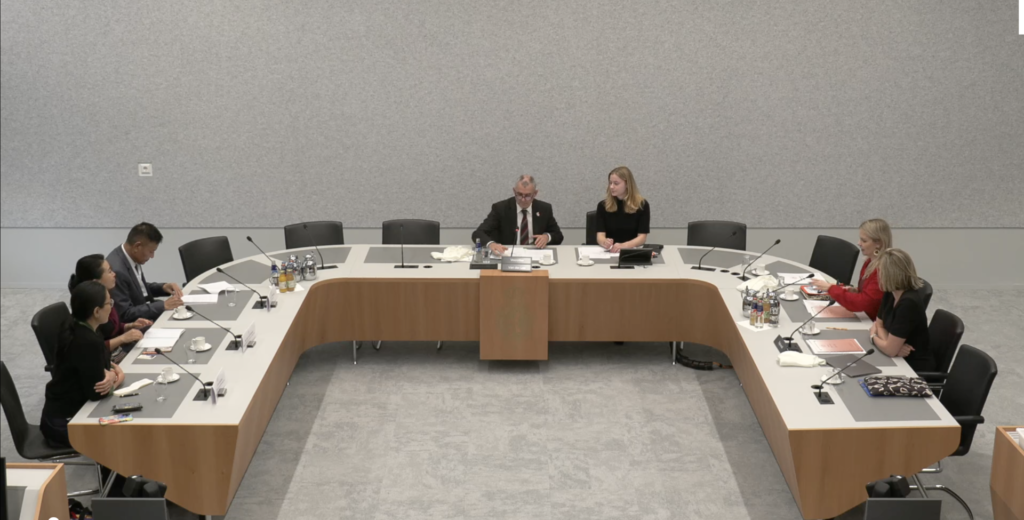
The Hague, Netherlands: Later in the afternoon, on the third and final day of his visit to The Hague, Sikyong Penpa Tsering, the democratically elected leader of the Central Tibetan Administration (CTA), addressed members of the Dutch Parliament’s Committee on Foreign Affairs at the invitation of the Committee. The exchange took place at the Tweede Kamer (House of Representatives) in The Hague and was livestreamed and open to members of the public to observe the proceedings from the visitors’ gallery. Sikyong was accompanied by Representative Rigzin Genkhang and ICT President Tenchoe Gyatso, alongside EU Advocacy Officer Tenzin Phuntsok of the Office of Tibet Brussels.
Following the welcome remarks by MP Tom van der Lee, who presided over the meeting, Sikyong began by expressing his appreciation for the Dutch Parliament’s continued support for Tibet, particularly through the adoption of resolutions over the past year. He also welcomed the Dutch Government’s principled support for religious freedom and the right of Tibetan Buddhists to determine the reincarnation of His Holiness the 14th Dalai Lama, as demonstrated by its joint statement with six other European countries issued on the occasion of the 90th birthday of His Holiness.
The delegation subsequently engaged in an in-depth hearing with members of the Committee on Foreign Affairs, attended by MPs Queeny Rajkowski, Hanneke Van der Werf, and Tom van der Lee. The discussion covered a wide range of issues concerning the political, religious, environmental, and human rights situation in Tibet. These included Tibet’s historical and legal status; food and water security concerns arising from China’s intensive damming of Tibetan rivers and its implications for downstream communities; restrictions on religious freedom; the erosion of Tibetan language and cultural identity under the PRC’s sinister “Ethnic Unity Law”; and China’s interference in Tibetan Buddhist religious traditions and the reincarnation process.
Referring to the enforced disappearance of the 11th Panchen Lama, Gedhun Choekyi Nyima, in 1995, Sikyong underscored the dangers of political interference in Tibetan Buddhist religious affairs. He also highlighted Beijing’s ongoing efforts to control Tibetan Buddhist succession through mechanisms like Order No. 5 and the controversial Golden Urn system, reiterating that the Chinese Communist Party lacks any legitimate authority over Buddhist reincarnation and succession.
He urged the MPs to explicitly reference the India-registered Gaden Phodrang Trust in all future parliamentary communications regarding the reincarnation of His Holiness the 14th Dalai Lama, reaffirming that the Trust holds sole responsibility and authority for recognising his successor.
Two rounds of questions allowed the parliamentarians to gain a deeper understanding of the Tibetan issue, facilitating a broader exchange on its political, historical, and diplomatic dimensions.
Reiterating a motion from the landmark resolution adopted by the Dutch Parliament in April 2025, Sikyong urged the lawmakers to work with their European counterparts towards establishing a dedicated EU Special Representative for Tibet mirroring the existing US model. He emphasised that the position would strengthen coordination, deepen understanding, and ensure sustained engagement on Tibet within EU institutions.
These engagements formed a key part of Sikyong’s three-day visit to the Netherlands, which commenced on 3 November 2026, and underscored the Central Tibetan Administration’s ongoing efforts to galvanise parliamentary and diplomatic support for Tibet across Europe.
Following the successful conclusion of his whirlwind visit, Sikyong departed the Netherlands for North America on 6 November.